Wednesday, 29 February 2012

Nudie Cohn - Rhinestone Cowboy


Nudie Cohn was the Russian-born tailor whose designs transformed the clothing of American country music. At one time a designer of highly embellished g-strings for New York strippers, Nudie moved to Hollywood in 1947 and originated the Rhinestone cowboy look that has become visual shorthand for a particular strain of country music style. His fantastical, intricately embroidered and heavily ornamented outfits have adorned the backs of countless stars within country music as well as those from the worlds of rock n roll, film and the rodeo. They include Elvis Presley, Roy Rogers, John Wayne, Hank Williams, Porter Wagoner, Gram Parsons, John Lennon, Cher, Dolly Parton, Johnny Cash and Elton John. Today his work is still sought after and admired. Contemporary musicians such as Bobby Gillespie from Primal Scream, Mike Mills from R.E.M. and Beck; fashion photographers including Craig McDean; and fashion designers from Tommy Hilfiger to Giles Deacon have been inspired by his incredible designs.

Tuesday, 28 February 2012

Art as Social Activism

“Art as social practice,” that’s the phrase that is often used to characterize a socially conscious form of creative expression that seeks to engage the artist and art work in humanitarian struggle.

You could say it is a predictable aesthetic resolution of a world that has devalued value, that suspects concepts of truth and beauty, that fears work being co-opted into propaganda or that asserts suppositions of cultural dominance or ideological superiority. It is the striving for art that is useful, to participate in social and political struggle, to quit making things that just stand around and create something that actually does something.

Get familiar with the concept; this isn’t the last you’ll hear of it in Dallas. It was the underlining theme of Creative Time’s visits to Dallas and the April symposium that was the culmination of that process. It is also a vision of art that Southern Methodist University’s art school is eagerly pursuing as a potentially defining characteristic. Coffee shop chatter suggests the possibility of the school moving their art department off the refined, faux-Georgian confines of its Park Cities campus and into one of Dallas’ more economically challenged neighborhoods. The school wants to roll up its sleeves and get into the thick of things.

Some of the cast of characters in town in April for SMU’s symposium – Creative Time, Project Row House’s Rick Lowe, the Queens Museum – make appearances in this ArtNews article about the movement. From the article:

One way or another, artists have acted as activists for centuries. But it seems that more and more artists around the world are devising projects that harness their creative sensibilities—and, significantly, their international profiles—to both raise awareness and improve living conditions. Brooklyn-based Swoon, for example, helped build a community center and shelters in Haiti. Vik Muniz advocates for Brazil’s garbage pickers. Most famously—and ominously—Ai Weiwei criticized shoddy construction in schools in China’s earthquake zones, along with other government policies, resulting in his detention last April.

Closer to home, curators Leila Grothe and Cynthia Mulcahy are organizing a community engaging project in South Dallas — a square dance at the Trinity River Audubon Center — that will be funded through grants from the Idea Fund and The Andy Warhol Foundation for the Visual Arts.

However, as the Ai Weiwei incident illustrated, the art world’s boisterous engagement of political activism comes with its own set of tough questions. Petitions were created to voice artists’ objections to China’s treatment of the WeiWei, yet while both artists and museum directors were vocal, other tougher measures remained off the table:

The prospect of more tangible measures—sanctions or a boycott—was regarded by several museum directors I spoke to as beyond the bounds of feasibility, given the realities of traveling exhibitions and loans, among other cultural, political, and financial entanglements.

But that doesn’t mean tougher measures won’t soon be part of the regular modus operandi of the activated art world, Creative Time chief curator Nato Thompson tells ArtNews. One petition that is currently circulating among artists demands regulation of labor conditions for migrant workers at the Guggenheim Abu Dhabi with the threat of eventual boycott. And before we dismiss these kinds of tactics, Thompson is quick – like everyone else these days – to point to the effectiveness of social networking activists in Tunisia and Egypt:

“These are new equations. Artists are finding they can organize and have power in a way they didn’t used to,” he notes. “They’re finding ways their community can demand ethical behavior.”

Surely, artist can demand ethical behavior. Artists, like everyone else, can demand whatever they want to demand. But the jury is still out on the more vital questions:

Are the Guggenheim Abu Dhabi’s conditions worse than those at other museums around the developing world? Will a boycott sever lines of communication with foreign institutions? Are there times when the solutions can become part of the problem? Can the art world really influence China’s human-rights policy?

c. Peter Simmek- FrontRow, Dallas

Mathew Derbyshire T Rooms at Tramway


I enjoy the doll's house-esque quality of this show and the use of pattern and architectural styles mixed up and basterdised to create a new and confusing approach to architectural representation.
However, on a conceptual level I can't say that I completely disagree with many points made in this rather scathing review. I also have a problem with art that deals with important social issues with an approach that comes from a very particular social perspective on what is right for 'society'. Perhaps if the artist was from the city his take on it's architecture might be an easier pill to swallow but as it is, the comment does some across as rather hollow.

Still, many of the aesthetics appeal to me and this is why I have included the show here.

http://www.scotsman.com/scotland-on-sunday/scotland/visual_art_review_matthew_darbyshire_t_rooms_tramway_glasgow_1_2125210

Friday, 24 February 2012

Ibsen- The Dolls House


A Doll's House (Norwegian: Et dukkehjem; also translated as A Doll House) is a three-act play in prose by the Norwegian playwright Henrik Ibsen.[1] It premièred at the Royal Theatre in Copenhagen, Denmark, on 21 December 1879, having been published earlier that month.[2]
The play was controversial when first published, as it is sharply critical of 19th century marriage norms.[3] Michael Meyer argues that the play's theme is not women's rights, but rather "the need of every individual to find out the kind of person he or she really is and to strive to become that person."[4] In a speech given to the Norwegian Women's Rights League in 1898, Ibsen insisted that he "must disclaim the honor of having consciously worked for the women's rights movement," since he wrote "without any conscious thought of making propaganda," his task having been "the description of humanity."[5] The Swedish playwright August Strindberg attacked the play in his volume of short stories Getting Married (1884).[6]
UNESCO inscribed Ibsen's autographed manuscripts of A Doll's House on the Memory of the World Register in 2001, in recognition of their historical value.[7]
Wikipedia

Tuesday, 21 February 2012

Hill of Crosses, Lithuania


Over the centuries, the place has come to signify the peaceful endurance of Lithuanian Catholicism despite the threats it faced throughout history. After the 3rd partition of the Polish–Lithuanian Commonwealth in 1795, Lithuania became part of the Russian Empire. Poles and Lithuanians unsuccessfully rebelled against Russian authorities in 1831 and 1863. These two uprisings are connected with the beginnings of the hill: as families could not locate bodies of perished rebels, they started putting up symbolic crosses in place of a former hill fort.
When the old political structure of Eastern Europe fell apart in 1918, Lithuania once again declared its independence. Throughout this time, the Hill of Crosses was used as a place for Lithuanians to pray for peace, for their country, and for the loved ones they had lost during the Wars of Independence.
Most recently, the site took on a special significance during the years 1944–1990, when Lithuania was occupied by the Soviet Union. Continuing to travel to the Hill and leave their tributes, Lithuanians used it to demonstrate their allegiance to their original identity, religion and heritage. It was a venue of peaceful resistance, although the Soviets worked hard to remove new crosses, and bulldozed the site at least three times (including attempts in 1963 and 1973). There were even rumors that the authorities planned to build a dam on the nearby Kulvė River, a tributary to Mūša, so that the hill would end up under water.
On September 7, 1993, Pope John Paul II visited the Hill of Crosses, declaring it a place for hope, peace, love and sacrifice. In 2000 a Franciscan hermitage was opened nearby. The interior decoration draws links with La Verna, the mountain where St. Francis received his stigmata. The hill remains under nobody's jurisdiction; therefore people are free to build crosses as they see fit.
Wikipedia

Monday, 6 February 2012

James Clarkson at Rhubaba

Rhubaba are delighted to announce A Chance Encounter Between an Umbrella and a Sewing Machine, the first Scottish exhibition by James Clarkson. Taking its title from Comte de Lautréamont’s 19th century prose poem, ‘Les Chants de Maldoror’, a seminal work of literature often sighted as an influence on the methodologies of French Symbolist, Dada and Surrealist movements during the 1920’s. Lautréamont was himself influenced by the works of Baudelaire and the two share an interest in the random possibilities or associations that occur when two unrelated objects or concepts meet in an unfamiliar situation.


From this basis, and taking Lautréamont’s text as a particular reference point, Clarkson will present a number of existing works reconfigured for the Rhubaba Gallery in an attempt to tease out tensions and relationships between disparate pieces.
The title of the exhibition, aside from its significance as a historical reference, is also used as a means of reflecting upon Clarkson’s use of found objects in the fabrication of his works.


The work ‘Two Birds in Space,’ previously exhibited as a public artwork, has been moved into the gallery and is presented as an expansive print, becoming a backdrop to the sculptural works on show. Brancusi’s ‘Bird in Space’ is pressed against a woman’s rear clad in gold hotpants that meld with the masterpiece. Clarkson brings together the formal attributes that circle between each of the images, allowing an equality of form to occur between them.

Monday, 30 January 2012

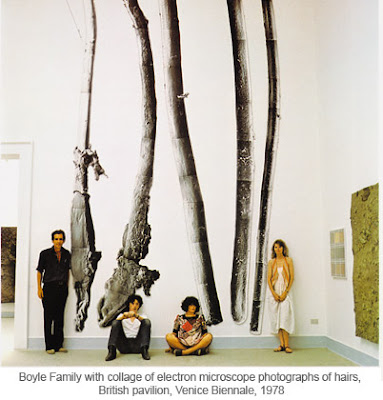
The Boyle Family


Boyle Family is a group of collaborative artists based in London. Mark Boyle and Joan Hills met in Harrogate, Yorkshire in 1957. Joan had studied art and architecture and was bringing up her first son Cameron whilst running her own business. Mark was in the army, writing poetry. After a period of working separately on visual art pieces, they incrementally moved into a natural collaboration - agreeing that art should not exclude anything as a potential subject.

Wherever Mark and Joan lived became their studio, so it seemed natural and necessary that friends and family be co-opted to help whenever there was a big show going off or an event to put on. From very early on, Mark and Joan’s children, Sebastian and Georgia, went around the studio, doing bits here and there, gradually getting more deeply involved: going on working trips, expeditions, helping to finalise and hang exhibitions. This co-creational approach also was applied to the evolution of the work itself and led to innovative and collaborative partnerships with many artists, performers, musicians, filmmakers and dancers, notably Jimi Hendrix and the psychedelic jazz-rock pioneers Soft Machine.

Originally the work went under Mark Boyle's name, largely because Mark and Joan were more concerned with making their work than attempting to fight the stereotype that artists were solo and usually male. Labels never mattered to them - it was the work that was important, not the marketing, image or personal recognition. Taking the view that if the art world wanted to believe in obsessed, lone male artists starving in their studios, they could present their work in a way that would fit. However, as their work became widely known, and at the same time the artistic stereotype began to broaden, they began to exhibit as Mark Boyle and Joan Hills. As adults, Sebastian and Georgia both opted to remain part of the team and since 1985 the four of them have exhibited as Boyle Family. Following the death of Mark Boyle in May 2005, Boyle Family continues to work and exhibit internationally, and to progress the execution of their best known work, the huge global World Series.

Boyle Family aims to make art that does not exclude anything as a potential subject. Over the years, subjects have included: earth, air, fire and water; animals, vegetables, minerals; insects, reptiles, water creatures; human beings and societies; physical elements and fluids from the human body. The media used have included performances and events; films and projections; sound recordings; photography; electron-microphotography; drawing; assemblage; painting; sculpture and installation.

Boyle Family is best known for the earth studies: three dimensional casts of the surface of the earth which record and document random sites with great accuracy. These works combine real material from the site (stones, dust, twigs etc) with paint and resins, preserving the form of the ground to make unique one-off pieces that suggest and offer new interpretations of the environment, combining a powerful conceptual framework with a strong and haunting physical and visual presence.

These ideas are strongly enshrined in the major Boyle Family work, World Series, initiated in 1968 as part of the exhibition Journey to the Surface of the Earth at the Institute of Contemporary Arts London. The World Series has been developed over the past forty years alongside a number of parallel and related series and projects including: the London Series; Tidal Series; Thaw Series; Japan Series. Each of these groups of work has involved various random selection techniques to isolate a rectangle of the Earth's surface. In the case of the World Series 1000 sites were chosen at random by visitors to the artists’ studio and the ICA exhibition. Participants were blindfolded and either threw a dart or fired an air rifle at an unseen wall-sized map of the world, which now forms part of the work itself.

This random selection serves several purposes: nothing is excluded as a potential subject; the particular is chosen to serve as a representative of the whole; the subjective role of the artists and creators is re-designated to that of ‘presenters’. Boyle Family seeks to present a version of reality as objectively and truthfully as possible, calling this process ‘motiveless appraisal’.

Once the random selection of subject has been made, the artists recreate the site in a fixed and permanent form as a painted fibreglass relief. They recognise that each work is in some respect necessarily flawed because the selections can never be truly random and that it is impossible to eliminate themselves and their own subjective influences. They attempt to present a slice of reality as they found it at the moment of selection, but no matter how good the re-creation, it is still a re-creation and only an approximation of reality. Boyle Family know that it is impossible to tell the truth, the whole truth and nothing but the truth, but in their work they try to isolate and reduce randomly chosen elements to as truthful an approximation as is within their power.

Their search is to find out if it is possible for an individual to free him/herself from conditioning and prejudice. To see if it is possible to look at the world, or a small part of it, without being reminded consciously or unconsciously of myths and legends, art of the past or present, art and myths of other cultures. ‘We also want to be able to look at anything without discovering in it our mothers' womb, our lovers' thighs, the possibility of handsome profit or even the makings of an effective work of art. We don't want to find in it memories of places where we suffered joy and anguish or tenderness or laughter. We want to see without motive and without reminiscence this cliff, this street, this field, this rock, this earth.’(1)